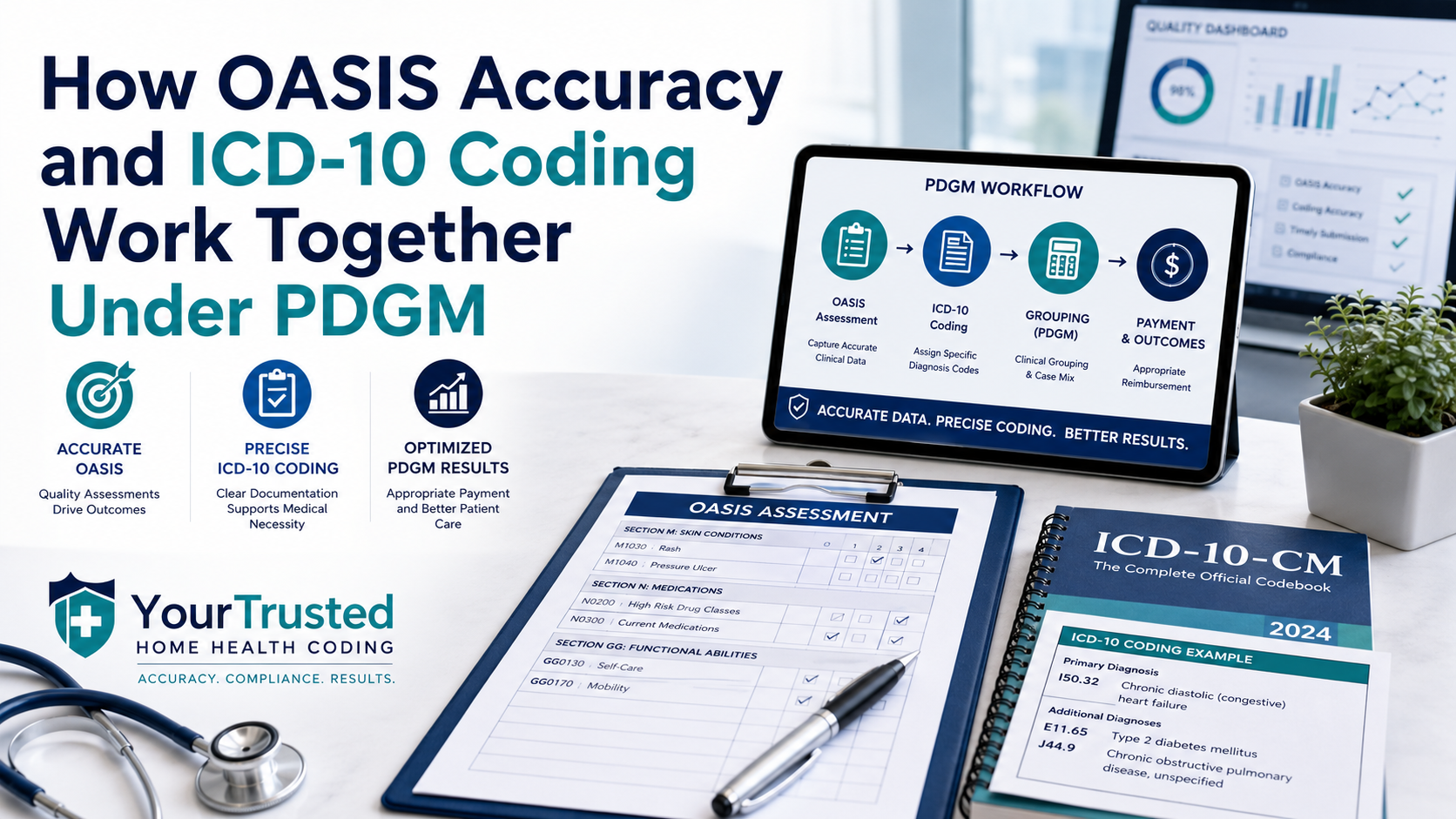


In home health, ICD-10 coding and OASIS review are often treated as two separate tasks handled at different stages of the process. Under the Patient-Driven Groupings Model (PDGM), however, ICD-10 coding and OASIS accuracy are closely connected. The primary diagnosis selected during coding and the responses recorded in the OASIS assessment both help shape how a home health episode is grouped and understood. When the two do not align, agencies can face additional review, follow-up requests, and slower turnaround times.
At Codexpo, we work with home health agencies to support ICD-10 coding, OASIS review, and 485 Plan of Care fill-in draft review. One pattern we see often is documentation where the coding and the OASIS information tell slightly different stories. Understanding how ICD-10 coding and OASIS work together under PDGM can help agencies submit cleaner cases and reduce avoidable delays.
What PDGM Relies On
PDGM places more emphasis on a patient’s clinical characteristics and documented condition than earlier models did. Several documentation elements carry significant weight, including the primary diagnosis, the patient’s functional level, and any relevant comorbid conditions. Each of these is drawn directly from the records and assessments submitted by the agency. You can review the official program details on the CMS Home Health PPS overview.
Because of this, the accuracy of the documentation matters more than ever. The primary diagnosis should be clearly supported by the medical record, and the OASIS responses should reflect the same clinical picture. When the documentation is complete and consistent, the case can move through the review process more smoothly.
How ICD-10 Coding and OASIS Support Each Other
ICD-10 coding identifies the patient’s conditions, while the OASIS assessment captures functional status and clinical detail at a specific point in care. These two sources should reinforce each other. A primary diagnosis selected during coding should be consistent with the patient’s documented condition, and the OASIS responses should reflect the same level of acuity and functional need.
When coding and OASIS are aligned, the overall record is easier to review and supports a clearer clinical picture. When they conflict, the case often requires clarification before it can be finalized. An accurate OASIS strengthens the coding, and well-supported coding reinforces the OASIS. The two work best together.
Common ICD-10 Coding and OASIS Mismatches
Many documentation delays under PDGM trace back to inconsistencies between the coding and the OASIS. Some of the most common issues include:
- A primary diagnosis that is not clearly supported by the OASIS or medical record
- Functional status responses that do not match the documented patient condition
- Comorbid conditions noted in the chart but missing from the assessment
- Diagnosis information that appears in one document but not the other
- Medication or clinical details that conflict across records
These mismatches may seem minor on an individual case, but across a high volume of admissions and recertifications they can create meaningful backlogs and repeated follow-up. For more on this, see our guide on common documentation issues that delay home health coding.
Keeping ICD-10 Coding and OASIS Aligned Before Submission
Agencies can reduce these issues by reviewing the coding and OASIS together before a case is submitted, rather than treating them as separate steps. A few practices help: confirming that the primary diagnosis is supported by both the medical record and the OASIS, checking that functional status responses match the documented condition, and making sure comorbidities are reflected consistently across all records.
Submitting a complete, organized documentation package from the start gives the review team a consistent picture to work from and reduces the need for back-and-forth clarification.
How Codexpo Supports This Process
Codexpo helps home health agencies review submitted documentation, compare the coding and OASIS information, and identify areas that may be missing, unclear, or inconsistent. When we find a mismatch between the coding and the assessment, we provide correction recommendations for the agency’s review. Our goal is to support documentation quality and a cleaner review workflow, while final clinical review, approval, dating, and signature remain with the appropriate licensed clinician and agency leadership.
Final Thoughts
Under PDGM, ICD-10 coding and OASIS accuracy are not separate concerns. They depend on each other, and the strength of one supports the strength of the other. By reviewing coding and OASIS together and submitting complete, consistent documentation, home health agencies can reduce delays and keep their cases moving more efficiently. If your agency wants support keeping ICD-10 coding and OASIS aligned, Codexpo is here to help with structured ICD-10 coding, OASIS review, and 485 Plan of Care review support.