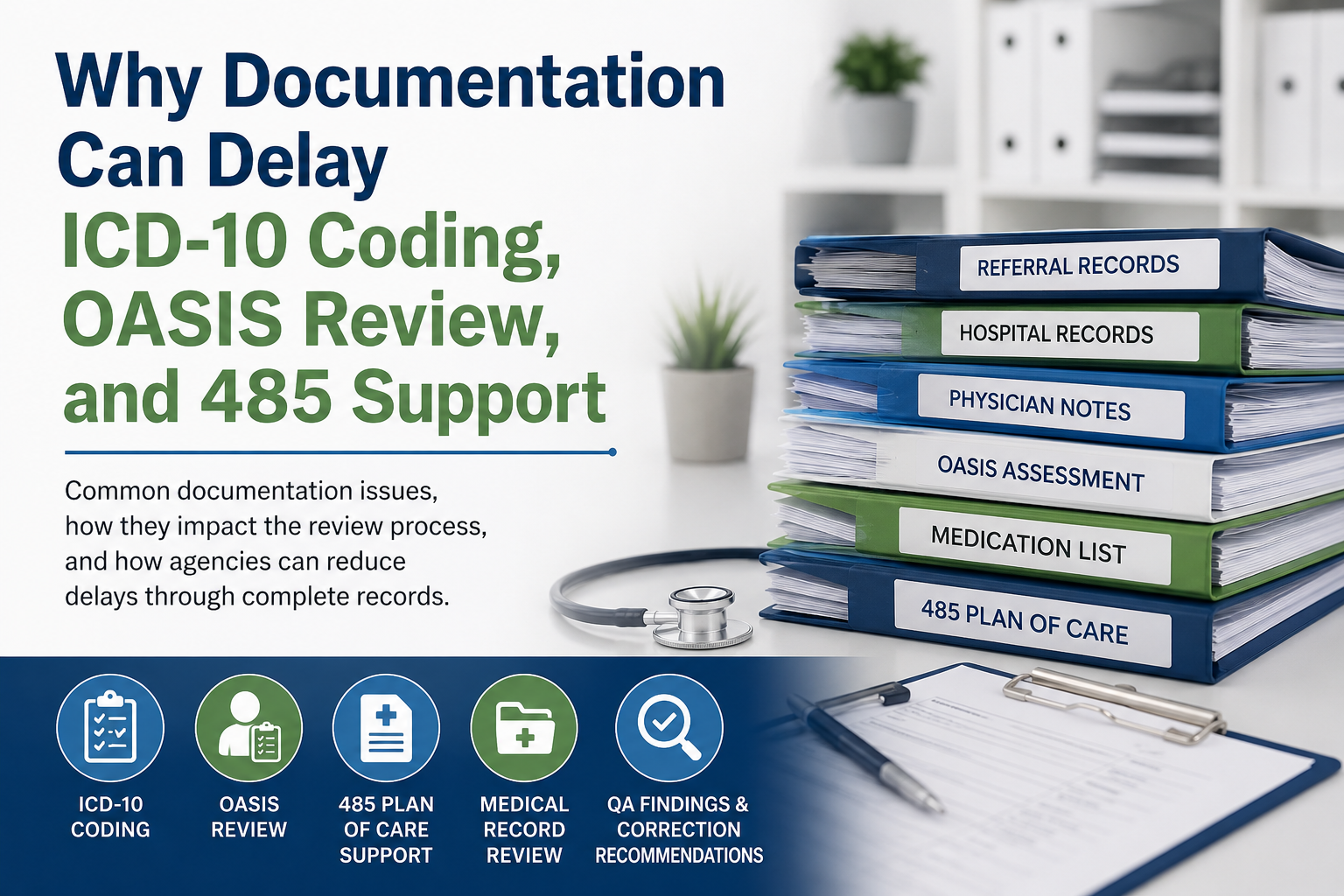
For home health agencies, accurate documentation is one of the most important parts of keeping cases organized and moving through the review process efficiently. ICD-10 coding, OASIS review, and 485 Plan of Care support all depend on the quality of the records submitted by the agency. When documentation is missing, unclear, or inconsistent, it can slow down the process and create unnecessary back-and-forth between the agency, clinicians, and review team. A strong documentation process helps agencies reduce delays, identify issues earlier, and keep records better organized for final clinical review. ICD-10 coding, OASIS review, and 485 Plan of Care support rely on the clinical information provided by the agency. The submitted records should support the patient’s condition, diagnosis information, medication details, OASIS responses, and care documentation. When records are incomplete or do not match each other, the review process may require additional clarification before the case can be completed. Submitting complete documentation from the beginning helps reduce delays and supports a cleaner review workflow.
Common Documentation Issues That Can Cause Delays
Several documentation issues can slow down ICD-10 coding, OASIS review, and 485 Plan of Care support. Most delays happen when important records are missing, unclear, or inconsistent with the information submitted for review.Missing Referral or Hospital Records
Referral records, hospital documents, discharge summaries, and physician notes often provide important support for the patient’s diagnosis and reason for home health services. When these records are missing, the review team may need to request additional information before completing the case.Incomplete Diagnosis Information
ICD-10 coding should be supported by clear documentation in the submitted record. If the diagnosis is unclear, incomplete, or not supported by the available documentation, the agency may need to provide clarification before coding can be finalized.OASIS Information Not Matching the Record
OASIS review is an important part of the documentation process. If the OASIS assessment does not match the medical records, referral information, or documented patient condition, the agency may need to review and correct the inconsistency. Common examples include mismatched functional status, missing clinical details, unclear diagnosis support, or documentation that does not fully align with the assessment.Missing or Incomplete Medication Lists
Medication information is often needed during documentation review and 485 support. If the medication list is missing, incomplete, or inconsistent with the chart, the review process may be delayed. Agencies should make sure current medication lists are included and match the available clinical documentation.Unclear or Missing Physician Documentation
Physician documentation, orders, certification information, and related clinical records may be needed to support the review process. When this information is missing or unclear, the agency may need to provide additional records before the case can move forward. Clear physician documentation helps support the overall record and reduces repeated follow-up.Incomplete 485 Information
The 485 Plan of Care review process can be delayed when demographic fields, diagnosis information, medication details, orders, or supporting documentation are incomplete. Codexpo may assist with 485 fill-in draft support, formatting, documentation comparison, and correction recommendations based on the records provided by the agency. Final clinical review, approval, dating, and signature remain with the agency’s appropriate licensed clinician or leadership.How Agencies Can Reduce Documentation Delays
Home health agencies can reduce delays by submitting complete documentation at the beginning of the review process. Before sending a case for ICD-10 coding, OASIS review, or 485 support, agencies should confirm that all available records are included and organized. A complete case submission may include referral records, hospital documents, physician notes, OASIS information, diagnosis support, medication lists, orders, and any documentation needed for 485 review. Submitting complete records helps reduce back-and-forth communication, supports a cleaner review process, and allows the agency’s clinical team to finalize documentation more efficiently.Codexpo’s Documentation Review Support
Codexpo supports home health agencies by reviewing submitted documentation, identifying missing or inconsistent information, and providing correction recommendations when needed. Our services are designed to support documentation quality, ICD-10 coding accuracy, OASIS review, medical record review, and 485 Plan of Care fill-in draft workflows. The goal is to help agencies maintain a cleaner and more organized review process while keeping final clinical decisions, approvals, and signatures with the appropriate licensed clinician and agency leadership. Final Thoughts
Documentation issues can create delays in ICD-10 coding, OASIS review, and 485 Plan of Care processing. Missing records, unclear diagnosis support, incomplete medication information, and inconsistent assessments can all slow down the review workflow. By improving case submission quality and identifying missing information early, home health agencies can maintain a more efficient documentation process. Codexpo helps agencies stay organized by providing ICD-10 coding support, OASIS review, medical record review, QA findings, and correction recommendations based on the documentation submitted.